
Nonprofit Web Design · Case Study
Nonprofit Website Redesign in Buncombe County, NC: Homeward Bound WNC Case Study
Published 2026-05-29 · 7 min read
Forty years of helping people in Buncombe County find and keep housing deserves a website that reflects it. When Homeward Bound WNC came to me, it didn't have one.
Key Takeaways
- A 40-year anniversary is a moment to build a site that reflects the scale of what's been accomplished, not just update what's there.
- The old homepage led with a fundraising event. The mission, services, and impact stats were all below the fold.
- New brand guidelines from Atlas Branding gave the site a visual identity that finally matched the organization's reach and reputation.
- A full 20-page technical audit before launch caught structural issues before real visitors hit them.
- Google Translate in the footer gives Spanish-speaking community members access to the full site without a separate translated version.
Homeward Bound of WNC has been working to end homelessness in Buncombe County for four decades. They provide homeless services, permanent supportive housing, rapid rehousing, and homelessness prevention — moving people off the street, helping them stay housed, and working to prevent housing loss before it starts.
When I first talked to Jessie Figueroa, their Resource Development Director, and Joe, their Communications Specialist, the organization was approaching a significant milestone. Forty years of impact. A new brand in development with Atlas Branding. And a website that hadn't kept up with either.
2,615+
People moved out of homelessness
82%
Remain housed after 12 months
40 years
Serving the WNC community
The Old Site: A Big Mission, a Small Stage
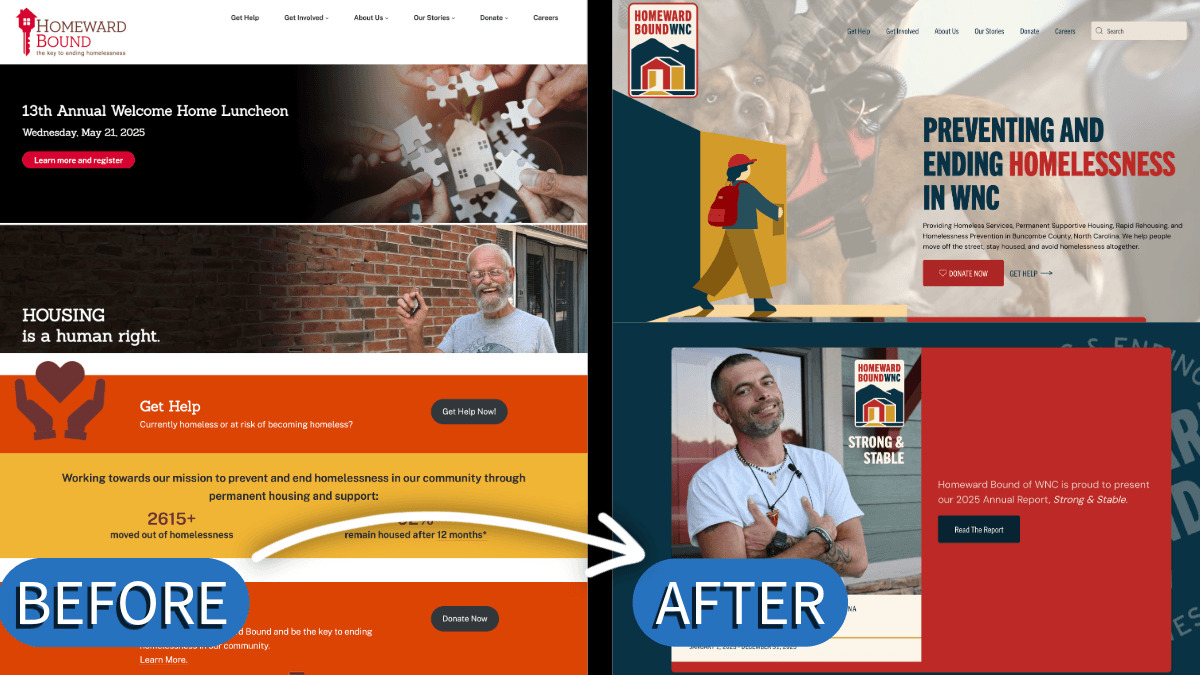
The old Homeward Bound homepage opened on the 13th Annual Welcome Home Luncheon. Date, time, registration link. Below that: a photo of a man in front of a brick wall with the words "Housing is a human right." Below that: an orange banner for "Get Help." Further down: a mission statement, impact numbers, and a donate button.
The organization had 2,615 people housed and an 82% 12-month retention rate. None of that was the first thing anyone saw.
For a donor arriving from a social media post or a Google search, the homepage raised an immediate question: is this org about the luncheon, or about ending homelessness? For someone in crisis looking for help, the path to "Get Help" required scrolling past event logistics first. The site was organized around internal priorities, not visitor needs.
Three Different People, One Homepage
Every visitor to a homelessness services homepage is there for a different reason, and the first 3 seconds either confirms they're in the right place or sends them somewhere else.
Someone experiencing homelessness or housing instability
Needs to know within seconds that this organization helps people in their situation. A fundraising event in the hero slot creates doubt about who the site is actually for.
A donor or funder
Wants to see proof of impact and a direct path to give. An org doing 40 years of serious work in Buncombe County deserves a site that communicates that scale immediately — not three scrolls in.
A volunteer or community partner
Wants to understand the programs and how to get involved. The old navigation and section structure made that harder than it needed to be.
What the Rebrand and Rebuild Delivered
The project started with a new brand system developed by Atlas Branding — updated guidelines, a new logo in a red-outlined style, and the Editorial Method typeface as a handwritten accent font throughout the site. Our job was to build a site that put that brand to full use.
The new homepage opens with the mission: Preventing and Ending Homelessness in WNC. The subheading covers the services in one sentence. Two primary CTAs sit immediately visible — Donate Now and Get Help — so the two most common visitor types each have a path without scrolling. Real photography of clients replaced the abstract imagery.
Mission-first hero
Bold headline and real client photography replace the event promotion. Who Homeward Bound is and what they do is clear in under 3 seconds.
Dual primary CTAs
Donate Now and Get Help are visible at the top. Both high-intent audiences have a direct path from the first screen.
New brand fully implemented
Atlas Branding's new logo, Editorial Method handwritten accent font, and updated color system applied consistently across all pages.
Rebuilt content sections
HOME, GET HELP, GET INVOLVED, and OUR STORIES all built from the ground up with current content and clear structure.
Google Translate in footer
Spanish-speaking community members can access the full site without a separate translated version — language access built into the global footer.
Old content preserved
Historical messaging, photos, and materials moved to a subdomain so the team retains internal access. Nothing deleted.
The QA Audit We Ran Before It Went Live
Homeward Bound didn't purchase an SEO package — but before the site launched, I ran a technical audit across 20 pages anyway. A site that looks finished and a site that is finished aren't always the same thing, and I'd rather catch the gap before visitors do.
What we found: a missing H1 on the Keynotes page, no favicon, and a footer link going to the wrong destination. Each one is a small thing. Together they're the kind of detail that signals "this wasn't fully checked" to anyone paying attention — a funder, a partner, a journalist. All of it was fixed before launch.
The site went live in April 2026. It loads fast on mobile and desktop, and the mission is the first thing anyone sees when they land on it.
Why the 40-Year Mark Mattered for This Project
When I talked to Jessie and Joe in April, the framing they used stuck: honoring 40 years of impact and building on the next 40. That's the right way to think about a rebrand at a milestone moment. The new site isn't a patch on the old one. It's a foundation for what comes next.
An organization that has housed 2,615 people and kept 82% of them housed a year later has earned a website that leads with that record. The old site buried it. The new one puts it front and center — because that track record is what makes a donor give, a volunteer sign up, and a community partner trust the referral.
This is the same question I work through on every project: what has this organization earned, and is the website reflecting it? For more on that approach, see the Storehouse of Henderson County case study or our full services page.
FAQ
When is the right time for a nonprofit to rebrand its website?
A milestone anniversary is one of the clearest signals. Forty years of impact in a community is a story worth telling with a site that matches it. When the brand and the website both reflect where the organization actually is — not where it was 10 years ago — donors, volunteers, and the people seeking help can all feel the difference immediately.
Does rebranding the website help with search visibility?
A stronger brand clarity helps, but specific technical decisions matter more. Updated page titles, a clear H1 on every page, a complete Google Business Profile, and fast load times across mobile and desktop are what move local search rankings. We ran a 20-page technical audit on Homeward Bound's site before launch to catch exactly those issues.
How do you handle language accessibility for a nonprofit website?
For Homeward Bound, we implemented Google Translate in the global site footer. This gives Spanish-speaking visitors access to the full site without building and maintaining a separate set of translated pages — a practical solution that doesn't require ongoing content duplication.
How do you handle the transition from an old site to a new one without losing content?
The old site content was moved to a subdomain so the team retained internal access to historical messaging, photos, and materials. Nothing was deleted. The new site launched clean, and the old content stayed accessible for reference.
Do you work with nonprofits outside of Buncombe County?
Yes. If your organization is in WNC and your site isn't reflecting what you've built — for donors, volunteers, or the people you serve — that's a fixable problem. Reach out at pixelatedstories.net or call (828) 888-0750.

About the author: Jason De Los Santos
Jason is the founder of Pixelated Stories in Asheville, NC. He works with local businesses and community organizations across Western North Carolina on websites, local SEO, and follow-up systems that connect them with the people they serve.
Is your site reflecting what your organization has actually built?
If your homepage buries the mission, hides the impact, or sends the wrong visitors in the wrong direction — that's a fixable problem. We work with nonprofits and community organizations across WNC.