
Nonprofit Web Design · Case Study
Nonprofit Website Redesign in Henderson County, NC: The Storehouse Case Study
Published 2026-05-29 · 7 min read
A food pantry's website has to serve three very different people at once: donors, volunteers, and families seeking food. Here's what happens when you give each of them their own path.
Key Takeaways
- A nonprofit homepage that tries to serve every audience at once usually serves none of them well.
- The Storehouse's old site put everything — pantry hours, campaigns, volunteer info, videos — on one scrolling page with no clear paths.
- Three entry points (Donate, Get Help, Volunteer) do more for a community org than any amount of design polish.
- Rebuilding the structure before the visuals prevents a beautiful site that still doesn't work.
- A campaigns section built to rotate seasonally keeps the site current without a redesign every drive.
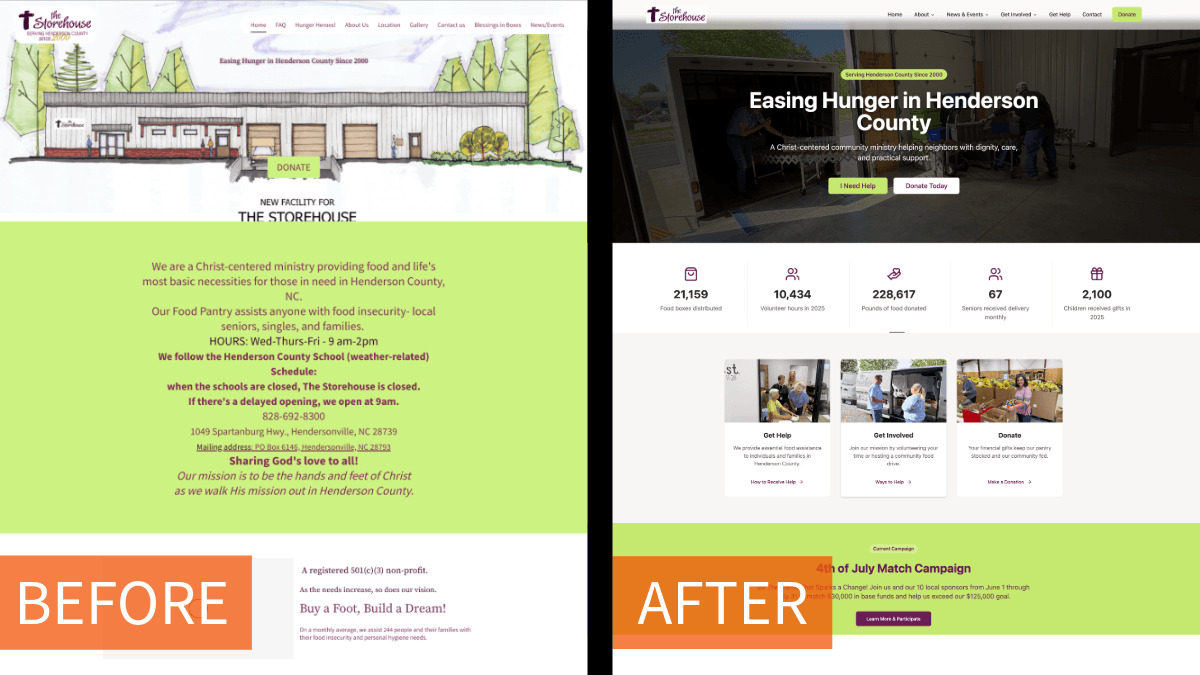
The Storehouse of Henderson County has been feeding families in the county since 2004. They're a 501(c)3 nonprofit food pantry — a Christ-centered ministry operating as My Father's Storehouse — providing food and basic necessities for anyone in need, three days a week, out of their new facility in East Flat Rock.
When Lynn Staggs first came to me, the organization had just moved into that new building. Karen Lundquist, who manages their media and communications, told me she was "truly looking forward to a new, updated design." The building was new. The mission was the same. The old website was neither.
21,159
Food boxes distributed
228,617 lbs
Of food donated
10,434
Volunteer hours in 2025
67
Seniors on delivery route monthly
2,100
Children received gifts in 2025
The Old Site: One Page Doing Five Jobs
Before I touched anything, I reviewed the existing site to understand what was broken. What I found was a single, continuous scrolling homepage with everything the organization does stacked end to end.
Mission statement. Hours. A building fund campaign. The full pantry list. Volunteer sign-up info. A seniors delivery program. Three embedded YouTube videos. A live Facebook post. All of it on one page.
The content was right. The structure was wrong. A donor landing on that page to make a quick contribution had to scroll past pantry hours and embedded videos before finding a donation option. Someone who needed food had to read through volunteer recruitment copy to get to the pantry list. A potential volunteer had to navigate fundraising language before finding a sign-up.
Three Audiences, One Page
Nonprofit websites fail most often because the information architecture was never built around the actual people using the site — and three very different people land on a food pantry homepage.
Someone seeking food
Needs clarity above everything. What days are you open? Where are you located? What do I bring? If the information is buried, a family in need may give up. That's a mission failure, not a bounce rate problem.
A donor
Needs to feel trust quickly and find a clear path to give. If they land on a cluttered page that looks dated, they may close the tab — and that donation goes somewhere else.
A volunteer
Has already decided they want to help. The only thing the website can do wrong at that point is make it hard to sign up.
What I Built Instead
Before writing a single line of copy or choosing any visual direction, I rebuilt the information architecture. The new site is built around three clear entry points visible immediately on the homepage: Donate, Get Help, and Volunteer. This is the same approach I take with every website project — structure first, design second.
Worth noting: the content for this build came together while the Storehouse team was physically moving into their new facility in East Flat Rock. Karen was coordinating photos, copy, and brand assets in the middle of a building transition. The new site had to be ready to reflect where they were landing, not where they'd been.
Homepage
Focused overview that routes each visitor to the right section. Impact stats visible immediately. No scrolling required to find your path.
Get Help page
Everything a family seeking food needs: hours (Wed–Fri, 9–2), location, eligibility, what to bring, and senior delivery info. No fundraising copy on this page.
Volunteer page
Sign-up info and current opportunities. Built for someone already motivated — the only job is removing friction.
Donate page
Trust signals and a direct giving path. Seasonal drives and campaigns — Building Fund, Blessings in Boxes, Coat and Blanket Closet — rotate here without touching the homepage.
News section
Staff-managed. Karen and Sarah can post schedule changes, snow day closures, or campaign updates in about 10 minutes — no developer needed.
Persistent Donate button
Visible across the entire site. Always accessible, never in the way.
Why Structure Comes Before Design
Most organizations think about a website redesign as a visual problem. The old site looks dated, so the solution is new colors, a new font, a better header photo.
Visual updates matter. But if you put new design on top of broken structure, you get an attractive site that still doesn't work. The Storehouse's challenge was that a donor, a volunteer, and a family seeking food all landed in the same place and had to figure out which content was meant for them.
That gets fixed by deciding — before any design work starts — who each page is for and what the one job of that page is. That's the work most agencies skip because it's slower and less visible than putting together a mockup. It's also the work that determines whether the finished site serves the mission. I apply the same thinking to business sites; the principle shows up in my contractor website conversion guide.
The site launched in spring 2026 and is live at storehouseonline.org.
FAQ
Do nonprofits need SEO on their website?
Yes, and the stakes are real. People in Henderson County search 'food pantry near me' or 'volunteer opportunities Henderson County' when they're ready to act. A properly structured site with clear page titles and a complete Google Business Profile will show up for those searches without a heavy SEO investment.
How do you handle a site managed by non-technical staff?
The news section and campaigns area are built so Karen and Sarah can post updates without touching any design files. Adding a closure notice or swapping a seasonal campaign takes about 10 minutes — no developer needed.
What happens to all the content from the old homepage?
Nothing gets deleted. Content moves to the right destination — the food pantry list lives on the Get Help page, volunteer info on the Volunteer page, past campaigns in an archive. The homepage gets shorter; the content gets better organized.
Does moving to a new building require a full site rebuild?
Not necessarily, but it's a good reason to revisit the structure. A new location means updated photos, a new address, and potentially new programs tied to the building. When the structure is right, those updates slot into the right place.
Do you work with nonprofits outside of Henderson County?
Yes. If your organization is in WNC and your current site isn't serving your community well — donors can't find the donate button, volunteers don't know how to sign up, the people you serve can't find your hours — that's a fixable structure problem. Reach out at pixelatedstories.net or call (828) 888-0750.

About the author: Jason De Los Santos
Jason is the founder of Pixelated Stories in Asheville, NC. He works with local businesses and community organizations across Western North Carolina on websites, local SEO, and follow-up systems that connect them with the people they serve.
Is your organization's website working for your community?
If your site has grown into a wall of content that's hard to navigate — for donors, volunteers, or the people you serve — the fix is usually structural, not cosmetic. I work with nonprofits and community organizations across WNC.